Didibet sports betting and racing
Didibet is a casino with a sportsbook bolted onto the side, and the sooner an Australian punter accepts that framing, the less disappointed they will be. The brand runs no trading floor of its own and prices none of its own markets. Not one Australian football code is advertised anywhere on the site. What it does instead is plug into a stack of Asian betting platforms (SBOBET, SABA, M8Bet/WBET, CMD and M9BET) and hand you their lines inside its own wrapper. There is a Horse Racing section, and in this market that matters more than it sounds. The brand’s own front page also carries a banner saying basketball bets are not accepted and will not be treated as valid — the kind of detail most review pages skip entirely. If you want the full picture of the operator before you commit a cent, the Didibet review hub covers the licensing, cashier and support side. This page is about the punt itself: who makes the price, what is actually covered, how Asian lines behave, and what it means to have your betting account sitting offshore.
Who actually makes the market
Every set of odds you see at Didibet comes from somewhere else. That is not a criticism, since it is how a large chunk of the grey market works, but it does change how you should read the product. With five aggregator platforms sitting behind one login, you are not betting “with Didibet” the way you bet with a licensed Australian corporate bookmaker. You are betting into a third-party pool, through an operator that takes your deposit, credits your balance and passes your stake along.
The practical consequences run deep. Settlement rules, void conditions, maximum payouts and market-specific quirks belong to whichever platform priced the bet rather than to the brand. Two markets on the same match, served from two different platforms, can settle differently on an abandoned game. Your bet slip will usually tell you which platform you are in, so look for the interface change: SBOBET, SABA and CMD all look distinctly different from each other. Getting into the habit of checking which room you are standing in saves a fair bit of grief later.
| Platform | What it’s strong at | What to watch for |
|---|---|---|
| SBOBET | The best known name in the stack. Deep soccer coverage, Asian handicap and over/under as the default market types, historically generous stake limits on major European football. | Its own house rules on postponements and neutral venues differ from Australian bookmaker convention. Market depth outside soccer thins out quickly. |
| SABA (SABA Sports) | Broad multi-sport menu built for Asian markets, with a familiar handicap-first layout and a large number of simultaneous events. | Liquidity is uneven — headline fixtures are priced tightly, minor competitions much less so. Limits on smaller markets can be modest. |
| M8Bet / WBET | A white-label style sportsbook that sits close to the casino product, so the balance and navigation feel continuous rather than bolted on. | The thinnest brand presence of the five. Terms are the platform’s, and you may need to dig to find them from inside the wrapper. |
| CMD (CMD368) | Known in the region for fast in-play pricing and a handicap ladder that moves quickly on live action. | Fast-moving lines mean more rejected slips and re-offers. If you are slow on the confirm button, expect price changes. |
| M9BET | Adds another feed of Asian-market events, which widens the total menu when the other platforms are quiet. | Least documented of the group. Treat its rules as unknown until you have read them in the product. |
None of this makes the odds bad. Asian books have a long reputation for pricing football sharply and tolerating serious stakes on top matches; that is exactly why they exist. It does mean the honest answer to “what are Didibet’s odds like?” is “which platform, and on what?” If you want one uniform book with one rulebook and one support desk behind it, the aggregated model will irritate you. Punters happy to shop between five feeds inside a single balance get more variety here than a single-provider site offers.
What Australians bet on, and what Didibet covers
The mismatch shows up here. Australia has one of the most distinctive betting cultures in the world, and it is not built around the sports Asian platforms price best. Among regular online punters in this country, AIFS survey data puts participation by code like this.
AFL reaches nearly six in ten regular online punters and NRL close to half. Those are the two biggest codes in the country by a wide margin, and neither is advertised anywhere on Didibet’s site. Soccer sits third at 28.5%, and it happens to be the one code the Asian stack does genuinely well. Basketball, on 25.1%, is explicitly switched off. Read that chart next to the table below and the shape of this sportsbook is hard to miss.
| Sport | Share of Australian punters betting on it | Covered by Didibet? | Notes |
|---|---|---|---|
| AFL | 58.5% | Not advertised | The biggest betting code in the country is not named anywhere on the brand’s public pages. Do not assume it is in there. |
| NRL | 49.0% | Not advertised | Same position as AFL — no public mention. Australian rugby league is not part of how this book presents itself. |
| Soccer | 28.5% | Yes — core strength | The Asian platforms are built around football. Handicap and totals markets on major European leagues are the deepest part of the menu. |
| Cricket | 27.4% | Not advertised | No public listing. Asian books often price cricket, but the brand makes no claim, so treat it as unconfirmed. |
| Basketball | 25.1% | Explicitly disabled | A banner on the brand’s own front page states basketball bets are not accepted and will not be counted as valid. This is a stated restriction, not a gap. |
| Tennis | 24.2% | Not advertised | Standard on Asian platforms but not promoted by the brand. Check the live menu rather than assuming. |
| Horse racing | The single largest code by turnover | Yes — dedicated section | There is a working Horse Racing area on the site. For an Australian punter this is the most relevant part of the offering. |
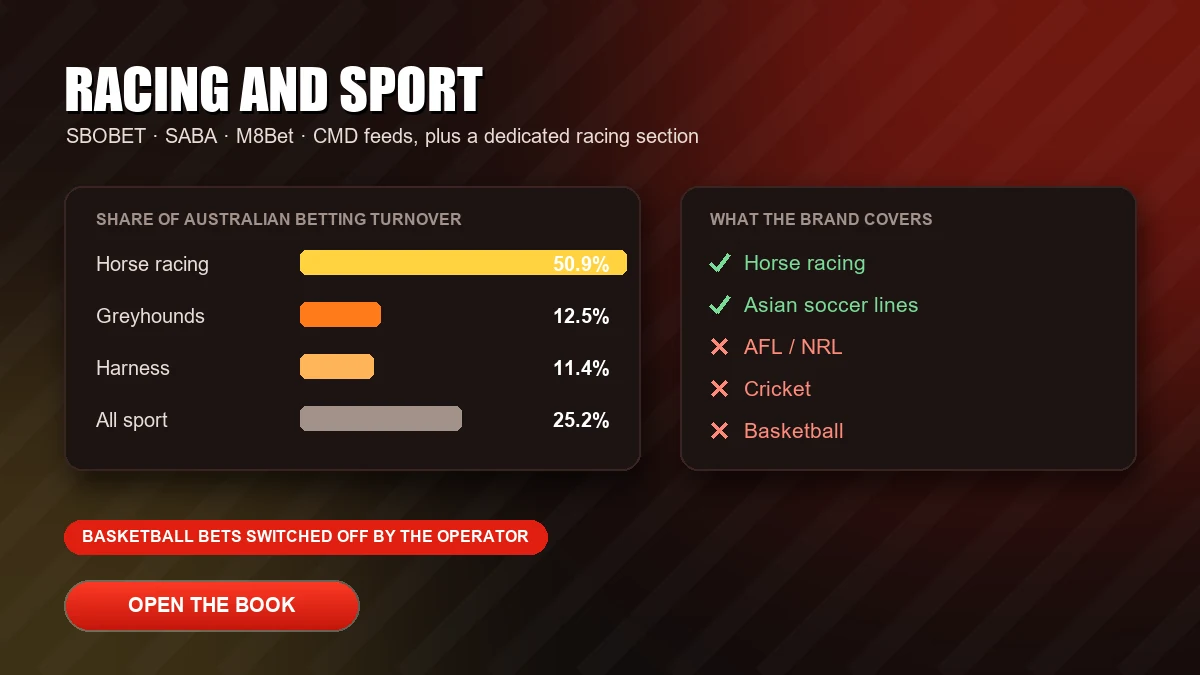
So: this is not a footy book. If your Saturday is built around AFL multis and NRL line bets, an aggregated Asian sportsbook is the wrong shop, and no amount of bonus money fixes that. Racing is the one place where it lines up with Australian habits, and racing, as the next section shows, is where the money in this country actually goes.
Open the Didibet sportsbookRacing: the part that actually fits the Australian market
Participation figures tell you what people bet on. Where the money goes is a separate question, and in Australia the two answers are not the same. Of total betting turnover, horse racing accounts for 50.9%, greyhounds 12.5% and harness racing 11.4% — three racing codes taking roughly three-quarters of every dollar wagered, while all sport combined sits at 25.2%. A sportsbook with a functioning racing section and no AFL is far less strange in this market than it first looks.
Win, place and each-way
The three building blocks of a racing bet have not changed in a century. A win bet pays only if your horse finishes first. A place bet pays if it finishes in the placings, which in Australian racing normally means the first three in fields of eight or more, first two in fields of five to seven, and no place betting at all in fields under five. An each-way bet is simply two bets of equal size, one win and one place, which is why a $10 each-way costs $20.
Each-way is the most misunderstood instrument on the card. Punters use it as a comfort blanket (“I’ll get something back if it runs third”) without ever doing the arithmetic. On a short-priced favourite the place dividend is often so small that the place half of the bet returns less than the stake you put on it, and you have effectively paid for insurance you cannot claim. Each-way earns its keep at bigger odds, where the place dividend is still meaningful. A rough working rule: below about $4 the win bet is usually better value on its own; well above that, each-way starts to make structural sense. That is a rule about bet construction, not a prediction about any particular race.
Fixed odds versus tote
Two entirely different pricing systems sit side by side in racing, and confusing them costs punters money every weekend. Fixed odds means the price is locked at the moment you strike — whatever happens to the market afterwards, you get the number on your ticket. Tote (parimutuel) means your money joins a pool, the operator’s takeout is removed, and the pool is divided among the winning tickets. Your final dividend stays unknown until the race is declared correct weight.
The strategic difference is straightforward. Fixed odds protect you against a firming market, tote protects you against a drifting one. Back a horse at $6 fixed, watch it get hammered into $3.20 by jump time, and you still keep the $6: that is the entire appeal of taking an early price. If the horse drifts to $9 instead, tote punters get the benefit and you do not. On offshore and aggregated books you should never assume which system you are on. Check whether the displayed price is guaranteed at the time of the bet or indicative, because the two look almost identical in a betting slip and settle completely differently.
Reading a race card
A race card is dense on purpose, and a fair bit of the skill in punting is knowing which columns to ignore. The ones that repay attention: barrier draw, which matters enormously at tracks with short runs to the first turn and on tight circuits; weight, because handicappers are explicitly trying to drag the field together and a horse carrying top weight is being told it is too good; recent form read as a sequence rather than a number, since a horse beaten four lengths in a Group race is a different animal to one beaten four lengths in a maiden; track condition, which in Australia runs on the Good/Soft/Heavy scale and reshuffles form lines completely once rain arrives; and jockey and trainer changes, which are the closest thing racing has to a public signal of intent.
The single biggest improvement most casual punters can make is to stop betting every race. A card of eight or nine races does not contain eight or nine bets. Usually it holds one or two where you have a genuine opinion and the price is wrong, and the rest is entertainment you are paying for. No bookmaker, Australian or Asian, is ever going to encourage you to be that selective. If you do most of your form study in transit, betting from your phone is worth setting up properly before raceday rather than fumbling with it two minutes before the jump.
Asian handicap and the lines you’ll meet
If you have only ever bet with Australian corporates, the markets on an Asian platform will look unfamiliar. There is often no draw option, the handicaps come in quarter increments, and a bet can settle as a half-win or half-loss. None of it is exotic once you understand what the format is trying to do: remove the draw and produce a near-even two-way market on every fixture.
Handicap basics
An Asian handicap gives one team a virtual head start expressed in goals, and the result is recalculated with that adjustment applied. Backing a team at −1.0 means it must win by two or more for a full win; win by exactly one and the bet is a push, with your stake returned. Backing at +0.5 means you win if your team wins or draws.
The quarter lines are what trip people up. A −0.25 line (often written −0/−0.5) splits your stake across two handicaps: half at level and half at −0.5. Win the match and both halves win. Draw it and the level half is refunded while the −0.5 half loses, so you drop half your stake. Lose and you lose the lot. A −0.75 line (−0.5/−1) works the same way in the other direction: win by two or more and you collect in full, win by exactly one and you get a half-win, anything else loses. These are standard settlement rules across Asian books, and they are why a bad Sunday on quarter lines rarely stings as much as the same Sunday on straight three-way betting.
Over/under
Totals work identically, with the same quarter-line mechanics applied to combined goals. Over 2.5 needs three or more. Over 2.75 (2.5/3) splits your stake: three goals delivers a half-win because half the bet sat on Over 3.0 and pushed, four or more wins in full, two or fewer loses everything. Totals are usually the first market a new punter should learn on an Asian book, because they depend less on which team you fancy and more on how you read the tempo of a fixture — a defensive away side protecting a lead, a dead rubber where nobody is chasing, a league where the referee gives eight minutes of added time as standard.
Why Asian books price differently
The economics are genuinely different, and that is worth understanding rather than taking on faith. A traditional three-way market is often built with a 6–8% margin baked in. An Asian two-way handicap market is frequently built much tighter: the classic structure is a pair of prices around 1.90 each side, which carries a margin in the low single digits. That figure illustrates how the format works. It is not a quoted Didibet price, and what you actually get depends on the platform, the competition and the moment you strike.
Tighter margins are funded by two things. First, volume: Asian books historically accept larger stakes on major fixtures than retail-facing Western operators, so they make their money on turnover rather than on a fat hold percentage. Second, sharp line movement. When serious money hits a market, the handicap moves — not just the odds, but the line itself, from −0.5 to −0.75 to −1.0 within minutes. That is the book protecting itself in real time, and it is why your bet slip may come back with a changed price or a re-offer before you have finished confirming. On a fast-moving platform like CMD this is routine, not a malfunction.
The flip side for a recreational punter is that “sharper price” and “easier to beat” are not the same sentence. A tight market is tight because the book is confident in the number. The margin saving is real and worth having if you were betting anyway, though it will not rescue a run of losing bets.
See the live line before you decide
Handicaps, totals and the racing section sit behind the login. Open the book, look at the actual markets on offer today, and judge the menu yourself rather than trusting any review.
The basketball ban, and what else is missing
Operators usually bury this one, so here it is plainly. The brand runs a banner on its own front page saying basketball bets are not accepted and will not be counted as valid. That is no temporary suspension of one league, and no quirk of a single platform. It is a blanket instruction from the operator, and it lands on a code that a quarter of Australian online punters bet on, according to AIFS survey data. Place a basketball bet somewhere in the stack anyway and you are backing a market the operator has already said it does not recognise. Expect no sympathetic hearing if it goes wrong.
The rest of the gaps are quieter but matter just as much:
- AFL, NRL and cricket are not advertised anywhere. Not “limited coverage” — simply absent from everything the brand publishes about itself. Anything you find in the live menu is the platform’s doing, not a product the operator is standing behind.
- Live in-play betting is not publicly confirmed. Some of the underlying platforms are known for in-play pricing, but the brand makes no claim, so treat in-play availability as something to verify in your account rather than a feature you are promised.
- Cash out is not publicly confirmed either. Build your bets on the assumption that a struck bet stays struck until it settles. If a cash-out button turns out to exist, treat it as a bonus rather than part of your strategy.
- There is no separate sports bonus. The bonus balance is shared with the casino, which means sports and racing stakes are being measured against terms that were written with slots in mind. Before you use bonus funds on a bet, read what counts toward rollover, because low-margin markets are the classic exclusion in that kind of scheme.
A shared balance has one consequence worth spelling out. When the sportsbook menu is thin on a given night and your funds are already sitting there, the pull toward the casino side is strong by design. If that is where you were heading anyway, the live dealer alternative is the part of this operator with genuinely established providers behind it. If not, remember that the shared wallet is an architecture choice rather than an accident.
Bankroll for punting
Sports and racing punish poor staking harder than casino games do, because the win rate is lower and the variance is longer-tailed. A slots session goes wrong inside an hour. With a punting bankroll it takes six weeks, which is exactly long enough to convince you it was bad luck rather than bad sizing.
Start with a unit. Decide what the total pot is, meaning money you have already written off, and make one unit 1% to 2% of it. On a $1,000 bankroll that is $10 to $20 a bet. It will feel too small, and that feeling is the point: a unit that feels exciting cannot absorb a normal losing run. Twelve losers in a row is unremarkable in racing. At 2% you are down 24% and still operating. At 10% you are gone.
Then pick a staking plan and hold it:
- Flat staking: the same unit on every bet, regardless of confidence. Boring, and the benchmark every other method has to beat. Most punters who track results honestly discover flat staking would have beaten whatever they were actually doing.
- Level-to-win: vary the stake so every winner returns the same profit. Common in racing, and it quietly means backing short-priced horses with much larger stakes, which is a bigger risk decision than it looks on the spreadsheet.
- Percentage of current bank: recalculate the unit as the bank moves. Self-correcting on the way down, slow to compound on the way up.
What destroys bankrolls is none of the above. It is the staking plan nobody admits to: upping the odds after a loss. The logic feels airtight in the moment — down $200, so take a $15 roughie and get it all back with one bet. What is actually happening is that you have swapped a market you had an opinion about for one you do not, at a price the book is very comfortable laying, at a stake chosen by your emotions rather than your maths. Chasing at longer odds is the fastest route from a bad week to an empty account.
Two housekeeping habits that cost nothing. Keep a record of date, selection, odds, stake and result, because a bankroll you do not measure is one you are guessing about. And separate the money properly: a betting balance should not be the same pool as rent. The mechanics of that separation start at the cashier, so read up on funding your betting account before you deposit rather than after.
What offshore betting means for an Australian punter
Didibet holds no Australian licence. It presents itself as operating under a Philippine regulator, and in October 2025 the Australian Communications and Media Authority added the domain to its blocking list under the Interactive Gambling Act 2001. Those are the facts, and the practical consequences are worth reading properly rather than skimming.
The Interactive Gambling Act targets operators, not players. An individual Australian placing a bet with an offshore site is not the person the legislation is pointed at, and there is no history of punters being prosecuted for it. That is the genuinely reassuring half. The other half is where the real exposure sits.
You have no regulator to escalate to. With a licensed Australian bookmaker, a dispute that support will not resolve can go to the state or territory licensing body and eventually to an independent complaints process. An offshore operator offers no such path: escalation ends at its own support desk, and whatever answer you get there is the end of the road.
BetStop does not reach here. Australia’s National Self-Exclusion Register covers licensed Australian wagering providers. An offshore book is outside that system entirely, which means someone who has self-excluded domestically can still open an account here. If self-exclusion is part of how you manage your gambling, take this seriously: the safety net you set up does not extend to this operator.
Consumer protections that are mandatory here simply do not apply. Australian-licensed bookmakers operate under rules on credit betting, inducement advertising, activity statements and deposit limits. None of those obligations follow an operator offshore. Add to that a domain already on a blocking list, so your access may depend on which ISP you are with and can change without notice, plus a balance shared with a casino product. The result is a set of risks that has nothing to do with whether the odds are any good.
None of this is a lecture about whether to bet. It is the information you need to decide how much to have sitting in the account, which is really the only decision that matters here. Keep the balance at a level you would not chase if it vanished, withdraw profits rather than letting them ride in the wallet, and screenshot anything the cashier tells you on the day.
18+ only. Gambling is a form of entertainment, not an income. If it has stopped feeling like entertainment, Gambling Help Online is free, confidential and available 24 hours a day on 1800 858 858.
Look at the book before you back anything
Racing section, Asian handicap lines and the platform menu are all visible once you are inside. Check what is actually on offer today. 18+ only. Gamble responsibly.
FAQ
Does Didibet take AFL and NRL bets?
Not that the brand advertises. Neither AFL nor NRL is named anywhere on Didibet’s public pages, which is striking given they are the two biggest betting codes in Australia, at 58.5% and 49.0% of regular online punters respectively. The sportsbook runs on Asian platforms built primarily around soccer, so Australian football codes are not what this book was assembled to serve. If either shows up in the live menu, it is the platform’s inclusion rather than something the operator promotes, so check before you plan a weekend around it.
Can I bet on basketball at Didibet?
No. The brand displays a banner on its own front page stating that basketball bets are not accepted and will not be counted as valid. That is an explicit operator restriction, not a temporary market suspension. Roughly a quarter of Australian online punters bet on basketball, according to AIFS survey data, so the exclusion is a meaningful one. Placing a basketball bet somewhere in the platform stack regardless would mean wagering on a market the operator has already declared invalid.
Does Didibet have live in-play betting?
Not publicly confirmed. Several of the underlying platforms, CMD in particular, have reputations for fast in-play pricing, but Didibet itself makes no public claim about live betting, so we are not going to state it as a feature. Treat in-play as something to verify inside your account. The same goes for any figure you see quoted elsewhere about live market counts, since the operator publishes nothing of the sort.
What is an Asian handicap?
A handicap that gives one side a virtual head start so the draw is removed and the market becomes a near-even two-way bet. Whole and half lines behave simply: at −1.0 your team must win by two or more, and a one-goal win is a push with your stake returned; at +0.5 you win if your team wins or draws. Quarter lines split your stake across two handicaps, which is how half-wins and half-losses happen. At −0.25, a draw loses you half your stake and refunds the other half. At −0.75, a one-goal win pays half. These are standard settlement rules across Asian books, not anything specific to one operator.
Does Didibet offer cash out?
Not publicly confirmed. There is no cash-out feature advertised on the brand’s pages, and availability on aggregated books usually depends on the individual platform rather than the operator. The safe planning assumption is that a bet, once struck, stays struck until it settles — so size every stake as money you cannot retrieve mid-event. If a cash-out button does exist somewhere in the stack, treat it as an unexpected extra rather than a tool you have built a strategy around.
Do sports bets count toward bonus rollover?
There is no separate sports bonus at Didibet. The bonus balance is shared with the casino side, and the wagering terms attached to it were written with casino play in mind. Low-margin markets such as short-priced favourites and tight Asian handicap lines are the classic exclusion in schemes like that, and the operator does not publish the detail publicly. Read the terms inside your account before you put bonus funds on a bet, because discovering the contribution rate after the bet has settled is the expensive way to learn it.