Didibet deposits and withdrawals
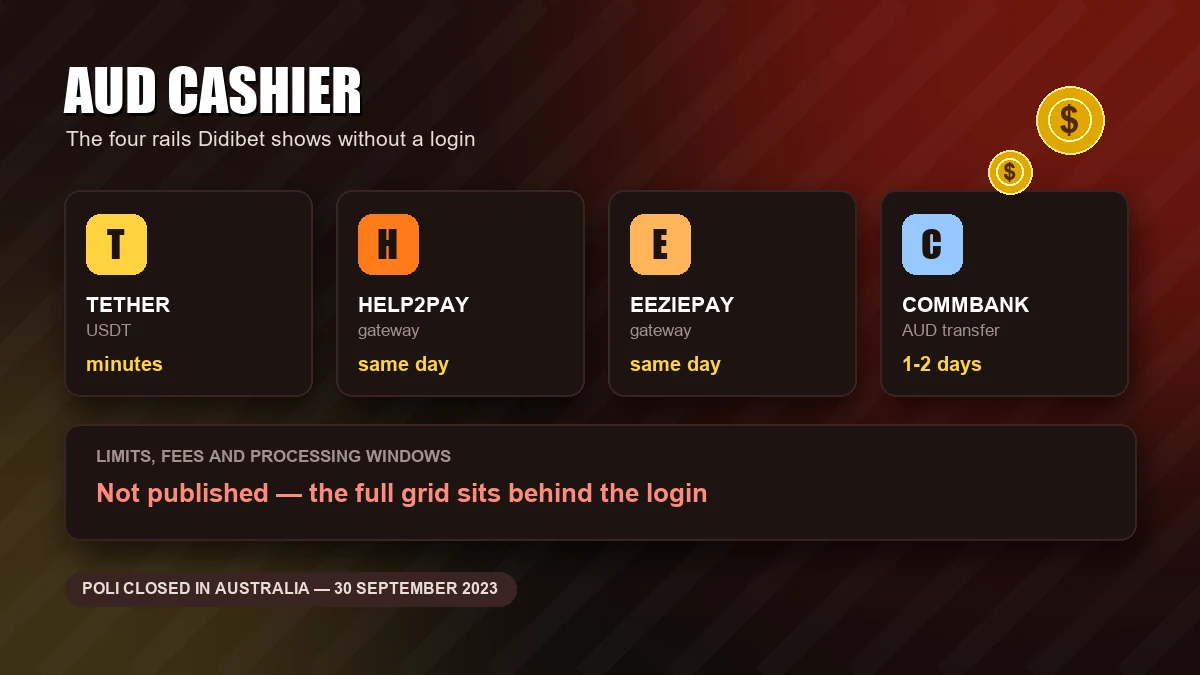
Didibet keeps most of its cashier behind the login wall. That is normal for an offshore book aimed at Australian punters — and it forces this page into two halves: what the brand actually shows in public, and what you will only see once an account exists. Publicly, four rails are visible on the site: Tether (USDT), Help2Pay, EeziePay and a direct Commonwealth Bank transfer in AUD. That is the whole list you can verify from the outside. Minimums, maximums, processing fees and cut-off times are not published anywhere on the site, and we are not inventing them to fill a table. If you want the rest of the picture before you touch the cashier, start with our Didibet Australia: full review and come back here for the money mechanics.
What follows is a rails-level breakdown. Which payment method runs on which network, what really sets the clock on a withdrawal, where Australian banking hours quietly add a day, and how the Australian payment market actually stands in 2026 — including two things most reviews still get wrong.
The rails Didibet shows publicly
Four methods appear on Didibet’s public pages. Three of them are not really “payment methods” in the consumer sense. They are gateways and networks that sit in front of your bank — and knowing which layer you are on explains most of the timing questions further down this page.
| Method | Deposit | Withdrawal | Realistic timing (rail behaviour, not an operator promise) | Limits published by Didibet |
|---|---|---|---|---|
| Tether (USDT) | Listed publicly | Not stated publicly | Minutes, once the required network confirmations land | Not published |
| Help2Pay | Listed publicly | Not stated publicly | Deposits near-instant; payouts follow the underlying bank rail | Not published |
| EeziePay | Listed publicly | Not stated publicly | Deposits near-instant; payouts follow the underlying bank rail | Not published |
| Commonwealth Bank transfer (AUD) | Listed publicly | Not stated publicly | 1–2 business days is the normal Australian bank-transfer window; offshore books often sit at the slow end | Not published |
Two things stand out. The direction of travel, deposit versus withdrawal, is not spelled out for any of the four. Plenty of operators accept a rail inbound and pay out on a different one, so “I deposited with X, therefore I can cash out with X” is an assumption to confirm inside your account rather than a fact. The other is the limits column, where every cell reads the same way because it genuinely is the same way — Didibet publishes no minimum, no maximum and no fee schedule outside the logged-in cashier. Anyone quoting you a hard “A$20 minimum, A$5,000 daily cap” for this brand is guessing.
The practical move is dull and it works. Open the cashier, screenshot the limits and fee text you actually see on the day, and keep the file. Offshore cashiers change gateways without announcement — and six weeks later, when you are arguing a case with support, a dated screenshot beats anything ever written about the brand.
Depositing in AUD
Didibet quotes in Australian dollars, so a deposit from an AUD account should not involve a conversion on your side. Crypto is the exception, and it gets its own section below. Here is how each public rail behaves.
Commonwealth Bank transfer
The plainest option on the list: a direct bank transfer in AUD to account details the cashier gives you. It is also the one most exposed to the Australian banking calendar. A transfer started inside a business day generally lands same day or next. One fired off on a Friday evening or over a long weekend can sit until the following business day before anything moves, and that delay sits on the banking side rather than with the operator.
Three details cause most of the trouble here. The reference code comes first. Bank rails carry a description field, and the code the cashier gives you is how your money gets matched to your account. Drop it, mistype it, or let your banking app truncate it — and your deposit turns into a manual reconciliation job for support instead of an automatic credit. Then there are third-party accounts: money sent from an account that is not in your name is a compliance red flag everywhere in this industry, and the fastest way to have funds frozen pending paperwork. Last, beneficiary details change. Offshore operators rotate banking partners, so the details that worked last month may not be the details in the cashier today. Copy them fresh every single time rather than re-using a saved payee.
Help2Pay and EeziePay
Both are Asian-facing payment gateways specialising in local bank transfers for online gaming, and both show up on Didibet’s public pages. From your side the flow is familiar: pick the gateway in the cashier, get redirected, choose your bank or follow the transfer instructions, confirm, land back on the site with the deposit credited. A gateway’s job is to make a bank transfer behave like an instant payment. When the plumbing is healthy that is exactly what happens, and the credit shows up in seconds to minutes rather than the day or two a raw transfer would take.
They misbehave in one particular way that is worth recognising. The money leaves your bank, the callback to the casino fails, and your balance stays flat while your statement says otherwise. Nothing is lost — the payment simply has not been matched. Give support the transaction reference and the timestamp, and resist the urge to fire off a second deposit. Sending a duplicate while the first is stuck is the single most common way punters turn a twenty-minute delay into a multi-day mess.
A gateway is also a middle layer with its own hours, its own bank relationships and its own maintenance windows. One gateway down while the other works is a statement about that processor’s overnight maintenance, not about Didibet’s solvency.
Tether (USDT) — the fast lane
USDT is the only rail on the public list that is genuinely independent of Australian banking hours. It settles on a blockchain and does not care that it is 2am on a Sunday in Melbourne. That is why crypto remains the default cash-out route at most offshore books.
The trade-offs are real, though, and they are not the ones people expect. Start with the exchange-rate step. Didibet runs AUD balances, so a USDT deposit is converted somewhere in the chain, and you wear the spread twice if you cash out the same way. The costlier mistake is network choice. USDT exists on several chains, and sending on a network the cashier does not support means the deposit does not arrive — and may never be recoverable. Copy the exact network name off the deposit screen, not from memory, and not from a review page. Then there is the confirmation count. “Instant” means instant to broadcast, followed by however many block confirmations the operator requires before crediting. On a congested day that is the difference between two minutes and forty.
One more point, less technical and more relevant in Australia. Acquiring the USDT in the first place means an exchange account, and that account comes with its own identity verification. Planning to fund a Friday-night punt with crypto you have not bought yet? You are looking at a two-day project.
What about PayID, Neosurf and cards?
None of them are publicly confirmed at Didibet. They may well exist inside the logged-in cashier, since plenty of gateways bundle them, but they do not appear anywhere on the public site. Treat them as available and you end up with a deposit plan that dies at the checkout screen. If PayID matters to you, check the cashier before you build a plan around it.
The same caution applies to your own bankroll planning. Settle the deposit method before you settle the stake, especially with a racing bankroll, where a Saturday-morning top-up either lands in time for the first jump or it does not.
Withdrawals: what actually sets the clock
Punters usually blame the operator for slow payouts, and sometimes that is fair. More often the delay is an unfinished verification file, a banking window that closed before your request was approved, or a blockchain waiting on confirmations. The rails themselves are rarely the bottleneck.
- USDT 40%
- Help2Pay / EeziePay 30%
- CommBank transfer 30%
Relative illustration of how the three publicly listed rail types compare on typical settlement speed, based on how those networks behave generally — not a measurement of Didibet’s processing and not figures published by the operator. Didibet does not publish payout times.
Verification first
Nothing else matters until this is done. Didibet’s terms allow it to request proof of identity, both sides of a card, a passport or a recent bank statement before releasing funds, and the request typically arrives when you ask for money rather than when you deposit it. That sequencing is standard across the industry. It is also why so many “the casino is stalling my withdrawal” complaints turn out, on inspection, to be a document that was never uploaded.
So front-load it. Complete ID verification on day one, while nothing is riding on it, using documents that meet the boring requirements: all four corners visible, nothing cropped, no glare on the photo page, a statement or utility bill dated within the last three months, and a name and address that match your Didibet account exactly. “Dave” on the account against “David” on the licence is enough to start a round trip — one that costs you two days. Didibet publishes no turnaround time for document checks, so assume it takes as long as it takes and get it out of the way early.
Weekends and banking windows
Any payout that touches an Australian bank account inherits the Australian banking calendar. Approval on the operator’s side is one clock; settlement on the banking side is another, and the second one stops on weekends and public holidays. A withdrawal approved at 6pm Friday is not a Friday payment. Realistically it arrives Monday or Tuesday, and a state public holiday pushes it further out. The offshore dimension adds a layer on top — processing teams and their banking partners are not necessarily on Australian time, so “next business day” may mean their next business day rather than yours.
Practical consequence: if you need funds for something specific, request the withdrawal early in the week and early in the day. A Sunday-night request feels productive and achieves nothing until Monday.
Crypto network fees and confirmations
Crypto payouts skip the banking calendar entirely, which is their whole appeal, but they run on a two-stage clock of their own. Stage one is the operator approving and broadcasting the transaction: human-paced, and the part that is invisible to you. Stage two is the network confirming it, fast and cheap on some chains, slow and expensive on others, depending on congestion at that moment.
Network fees come out of the amount in transit, which makes small withdrawals disproportionately expensive — a fee that is trivial on A$2,000 is painful on A$60. Didibet does not publish whether it absorbs network fees or passes them on, so check the confirmation screen for the net figure before you approve. Once a transaction has a hash, the operator’s part is finished. Paste the hash into a block explorer and you can see for yourself whether it is pending or confirmed, which is quicker than asking support.
Australian payment landscape in 2026
Two pieces of received wisdom about Australian gambling payments are now simply wrong, and a third is widely misunderstood. Here is the current state of play.
| Method | Status in Australia, 2026 | Typical speed | Notes |
|---|---|---|---|
| PayID | Alive and mainstream, running on the New Payments Platform | Usually under 60 seconds, 24/7 | Not publicly confirmed at Didibet — check the logged-in cashier |
| POLi | Dead in Australia. Australia Post shut POLi’s Australian service down on 30 September 2023 after banks stopped accepting it over security concerns | n/a | Still operates in New Zealand. Any 2026 review promoting POLi for Australian players is recycling stale copy |
| Neosurf | Alive; prepaid vouchers sold at Australian retail in A$10 / A$20 / A$50 / A$100 | Instant on deposit | Normally deposit-only — a voucher cannot receive a payout, so you need a second rail to cash out. Not publicly confirmed at Didibet |
| Credit and debit cards | Banned for licensed Australian wagering operators since 11 June 2024 under the Interactive Gambling Amendment (Credit and Other Measures) Act 2023 | Instant where accepted | The ban binds licensed Australian operators. Offshore sites sit outside that framework — and your own bank may still decline the transaction regardless |
| Crypto (USDT and similar) | Covered by the same 2024 measure for licensed Australian wagering operators; offshore books continue to accept it | Minutes, network-dependent | The one rail Didibet confirms publicly |
| Direct bank transfer | Alive and universal | 1–2 business days; slower over weekends and public holidays | Commonwealth Bank transfer is Didibet’s publicly listed fiat option |
The card and crypto row deserves unpacking, because that is where most confusion lives. The 2024 amendment applies to operators licensed in Australia — the ones you see advertising during the footy. It stops them accepting credit cards, credit-linked digital wallets and digital currency for wagering. Didibet is an offshore operator with no Australian licence, so that rule does not govern its cashier, which is exactly why crypto sits on its public payment list in the first place.
In plain terms rather than legal ones: the consumer protections attached to the licensed market (the credit ban, the national self-exclusion register, an Australian regulator to complain to) are not part of the deal offshore. Your bank may also block or flag gambling-related transactions independently, a decision it makes on its own terms. This page is not legal advice and cannot tell you what is right for your situation. It can tell you the framework is different, and that the difference shows up precisely when something goes wrong with a payment.
See the cashier for yourself
Public pages list four rails. The live limits, fees and payout options sit behind the login — open it and screenshot what you see.
Step by step: your first deposit
- Finish the account first. Register with the name exactly as it appears on your ID, not a nickname and not a shortened first name. Our guide to account setup walks through the fields that matter later.
- Upload documents before you fund anything. Ten minutes now beats two days of waiting when you want your money back out.
- Open the cashier and read the actual numbers. Minimums, maximums and any fee text live on that screen and nowhere else. Screenshot them.
- Pick the rail that matches your timeline. If you need funds live in minutes, that means crypto or a gateway. Happy to wait a day and keep everything inside your bank? Commonwealth Bank transfer.
- Copy the payment details fresh. Reference code for a bank transfer; wallet address and network for USDT. Never a saved payee, never a wallet address from your clipboard history.
- Send exactly what the cashier expects. Same account holder, same currency, same network. Third-party payments are the most reliable way to freeze your own funds.
- Confirm the credit before you play. Refresh the balance. If it has not landed within the expected window, take the reference to support — do not send a second payment.
- Check the bonus fine print before you opt in. A deposit attached to a promotion carries conditions that affect what you can withdraw and when; see bonus terms and payouts for how that plays out.
Step by step: your first withdrawal
- Confirm verification is complete, not “submitted”. There is a difference, and it is a day or two wide.
- Clear any active bonus. Funds tied to a promotion are generally not withdrawable until its conditions are met; requesting a payout mid-bonus can forfeit the balance outright at some operators.
- Request early in the week, early in the day. You want the approval and the banking window on the same business day.
- Choose the destination deliberately. Same-account, same-name, same-currency wherever possible. For crypto, triple-check the network — a payout sent to the wrong chain is gone.
- Read the net amount on the confirmation screen. That is where any fee becomes visible. Didibet publishes no fee schedule publicly, so the confirmation screen is your only source.
- Record everything. Request ID, timestamp, amount, method. A screenshot at this moment is what makes a support conversation short.
- Let the clock run before chasing. For crypto, once you have a transaction hash the operator’s part is finished — check a block explorer. For a bank transfer, give it two business days before escalating.
When a payout stalls
Most stalls have an ordinary cause, and working through them in order resolves the majority without any drama.
The usual suspects, in the order they actually occur. An outstanding verification document is far and away number one, often a request sitting unread in an email filter or in the site’s message centre. Second is a name or detail mismatch between your account and the destination account, which trips automated checks. Third is an active bonus still holding the balance. Fourth is timing — a request approved after the banking cut-off, or over a weekend, that was never going to move until the next business day. Fifth is a gateway-side issue: maintenance or a processor outage that has nothing to do with your account. Rarest of all is a genuine review flag that requires a human to sign off.
What to do, in order. Check your account’s message centre and your email, spam folder included, for a document request. Re-read the withdrawal’s status in the cashier instead of relying on what you remember it saying yesterday. Then open live chat with the specifics ready: request ID, timestamp, amount, method, and the destination’s last four digits or the wallet address. Ask one direct question: “what is the current status and what do you need from me?” Get that answer in writing. If chat cannot resolve it, escalate by email to create a paper trail, and use the WhatsApp or Telegram contacts as a follow-up channel rather than a replacement.
What not to do. Do not submit a second withdrawal request while the first is pending; duplicates routinely cancel each other and reset the queue. Do not change your withdrawal method or destination mid-request, which forces re-verification. Do not gamble the pending balance back, because the delay is rarely what a slow payout really costs you. The tilt is. And do not lodge a chargeback against a deposit to force the issue; that ends accounts and forfeits balances rather than recovering them.
Keep your expectations calibrated too. Didibet is an offshore operator with no published payout SLA, a Gmail support address rather than a corporate domain, and no presence on the major complaint-resolution platforms. None of that is an accusation. It is a description of the escalation options open to you, and they are thinner than they would be with a licensed Australian book. Size your balance accordingly, and withdraw regularly rather than letting a large sum sit in the account.
Ready to move money?
Bank transfer, gateway or USDT — the live options, limits and fees sit inside the cashier.
Keeping control of the bankroll
Payments are where bankroll management is actually enforced, so be deliberate about them. Fund with a fixed amount on a fixed schedule rather than topping up in the middle of a session; a mid-session deposit is the clearest signal that the session should have ended. Withdraw on a schedule too. Money sitting in a casino balance is money you are statistically going to re-stake. Where the operator offers deposit limits, set them while you are calm, because a limit exists to bind the version of you who is not.
If crypto is your rail, its speed cuts both ways: a two-minute deposit strips out the cooling-off period a bank transfer builds in by accident. And funding a punt with money earmarked for something else is not a payments problem. No cashier feature fixes that one.
Gambling is for adults only — 18+. If it has stopped being entertainment, free and confidential help is available in Australia through Gambling Help Online on 1800 858 858, 24 hours a day, seven days a week.
FAQ
How long does a Didibet withdrawal take?
Didibet does not publish a payout time, so any specific figure you see quoted has been invented. What can honestly be said is how the rails behave. A crypto payout settles in minutes once broadcast and confirmed, while anything landing in an Australian bank account follows the 1–2 business day bank-transfer window and stops for weekends and public holidays. Your verification status moves the needle further than the rail does.
Does Didibet support PayID?
Not publicly confirmed. PayID is alive and well in Australia, running on the New Payments Platform and usually settling in under a minute around the clock, but it does not appear on Didibet’s public pages. The full payment grid sits behind the login, so check the cashier in your account before planning around it.
Can I still use POLi?
No. POLi’s Australian service was shut down on 30 September 2023 by its owner, Australia Post, after banks stopped accepting it over security concerns. It still operates in New Zealand, which is why outdated review pages keep listing it. If a 2026 article recommends POLi to Australian players, it has not been updated in three years.
Do I need to verify my identity before the first withdrawal?
Expect to. Didibet’s terms reserve the right to request proof of identity, both sides of a card, a passport or a recent bank statement before releasing funds, and that request typically arrives at withdrawal rather than deposit. No turnaround time is published. Uploading documents on day one, with names and addresses matching your account exactly, removes the single most common cause of payout delays.
Does Didibet charge fees on deposits or withdrawals?
No fee schedule is published outside the logged-in cashier, so there is no honest public answer. What you can control: check the net amount on the withdrawal confirmation screen before approving, and remember that crypto network fees come out of the amount in transit, which makes small crypto withdrawals disproportionately expensive.
Can I withdraw to a different method than I deposited with?
Not something Didibet states publicly, and not something to assume. Industry practice is to return funds to the source where possible, with crypto payouts going to a wallet you control. Mismatches between the deposit source and the payout destination are a standard trigger for extra checks, so keep the account name and details consistent across both ends.
What should I do if my withdrawal is stuck?
Work through it in order: check the site’s message centre and your email for an outstanding document request, confirm no active bonus is holding the balance, then contact live chat with the request ID, timestamp, amount, method and destination ready. Get the answer in writing and escalate by email to keep a paper trail. Do not submit a duplicate request, do not change the destination mid-request, and do not re-stake the pending balance.